
Knowledge Center
Tint Meter for Window Film Installers: How to Verify Film VLT Before Handing Over the Keys
Quick answer: A tint meter for window film installers measures the visible light transmission (VLT) of the finished window, meaning film and glass together. Testing before handover confirms the job matches what you quoted and gives you a reading on record if the customer ever asks.
Why verify VLT before the customer drives away
The VLT printed on a film box describes the film. The window the customer actually sees is film plus glass, and some glass is already tinted from the factory. The combined result can read differently from the film's rated number. A meter shows what the finished window really measures, so you find out at your shop and not at a roadside check or an inspection station.
EDTM's Tint-Chek meters are designed to measure VLT through automotive glass and any glass/film stack up to 1/4 inch (6.5 mm) thick, which covers typical vehicle glass.
Local tint laws vary by state and country, so check your own regulations for the limits that apply to each window. This article does not quote legal limits.
What a tint meter actually measures
VLT is the percentage of visible light that passes through the glass and film. The meter shines a light through the window and reports how much arrives on the other side. The Tint-Chek PRO user guide lists its light source wavelength as 550 nanometers, a point near the middle of the visible spectrum.
Which type of meter should an installer choose?
There are two main designs:
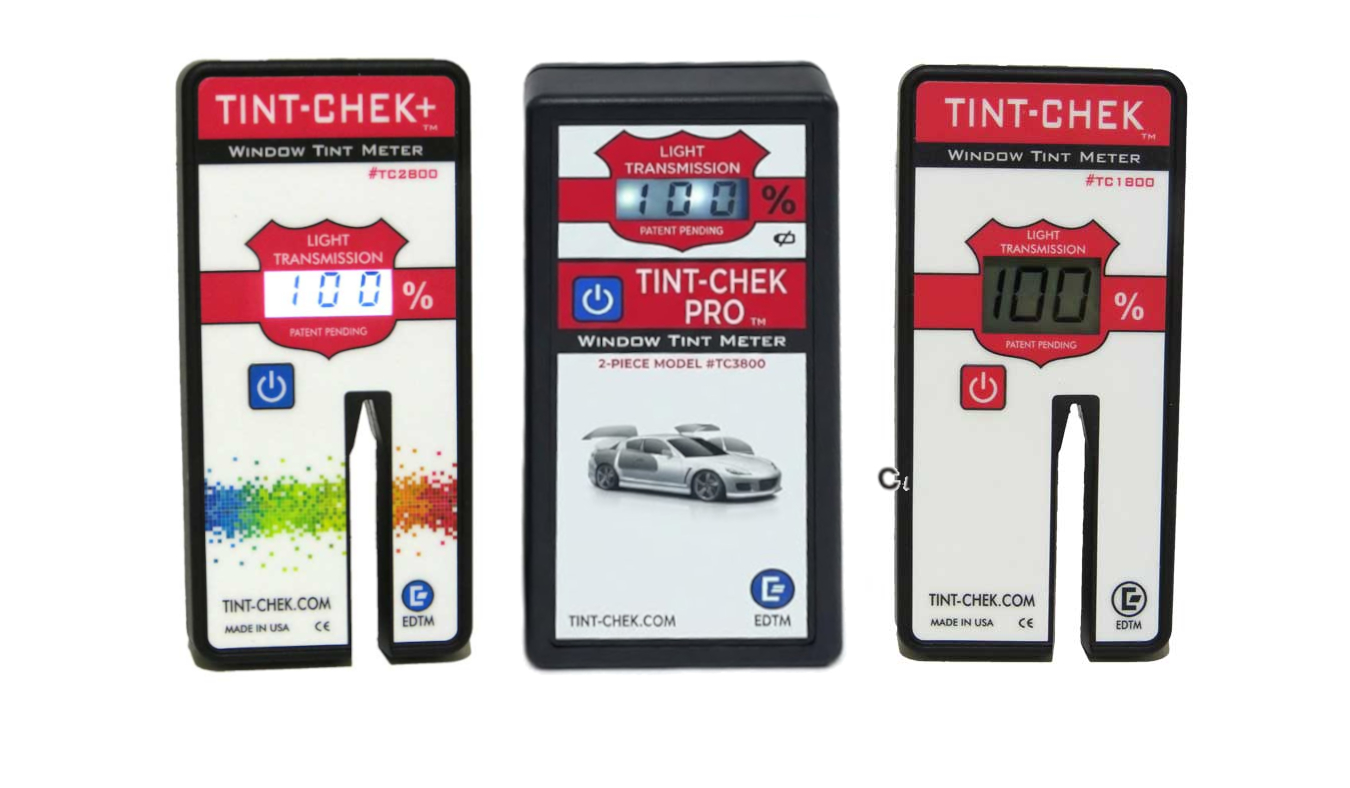
• Horseshoe meters (such as the TC2800 Tint-Chek) slide over the edge of a lowered side window. EDTM lists the TC2800 with a backlit display and a reading to the nearest 0.1%.
• Two-piece meters (the TC3800 Tint-Chek PRO) place one part on each side of the glass, so they can test windshields and rear windows as well as side windows.
A horseshoe design cannot reach rear windows or windshields, according to retailer guidance from Instrument Choice. If your shop tints back glass or windshield strips, plan on a two-piece meter.
How to verify VLT step by step
1. Clean the glass. The TC3800 user guide warns that dirty glass can affect results.
2. Check the film manufacturer's guidance on when freshly applied film should be tested.
3. Verify the meter with its calibration standards before you start. The TC3800 ships with two standards, at roughly 27% and 59% VLT.
4. Take readings in at least two spots per window and note any large difference between them.
5. Compare the reading to your quoted film and the legal limit for that window.
6. Record the result before handing over the keys.
For a deeper walkthrough, read how to measure tint and VLT accurately.
What to record for each job
|
Field |
Why it matters |
|
Date and vehicle |
Links the reading to one job |
|
Window position |
Front, rear, and side windows can differ |
|
VLT reading |
The proof of what you delivered |
|
Meter model and serial number |
Shows which instrument was used |
|
Installer name |
Accountability |
Common mistakes to avoid
• Measuring dirty or smudged glass.
• Skipping the calibration standards check.
• Letting the two pieces of a two-piece meter sit misaligned or tilted.
• Running on a weak battery. These meters use a 9V alkaline battery.
• Recording one reading for the whole vehicle.
Frequently asked questions
Is the VLT on the film box the same as the final reading?
Not necessarily. The box number is for the film. The finished window includes the glass, so the combined number can be different.
Can I test a windshield with a horseshoe meter?
No. Horseshoe designs fit over lowered side glass. Use a two-piece meter for windshields and rear windows.
Do I need to record readings?
It is not a substitute for local legal requirements, but a written record is the easiest way to resolve a customer question later.