
Knowledge Center
How Window Tint Is Measured: Testing Methods, Tolerances, and Industry Standards Explained
Quick Answer
Window tint is measured as Visible Light Transmission (VLT), the percentage of visible light that passes through the glass and any film applied to it. A window tint meter shines a light source through the glass, reads how much reaches a sensor, and displays the result from 0 to 100%. A lower VLT number means darker tint. Every EDTM Tint-Chek meter reads to an accuracy of +/- 2 percentage points, and each one is factory calibrated to a NIST traceable standard.
Key Takeaways
• VLT is the measurement that matters for tint. It describes how much visible light gets through, not how dark a window looks to the eye.
• A handheld tint meter measures light passing through the glass at 550 nanometers, close to the middle of the visible spectrum.
• Tolerance is part of every measurement. All Tint-Chek models are accurate to +/- 2 percentage points with 1 percentage point repeatability.
• Resolution is not accuracy. Some models display to 0.1% and others to 1%, but every model carries the same +/- 2 percentage point accuracy.
• Verify your meter regularly with the two NIST traceable calibration standards (about 27% and 59% VLT) included with each meter.
What Does VLT Mean in Window Tint?
VLT stands for Visible Light Transmission, sometimes written as Visible Light Transmittance. It is expressed as a percentage. A window with a VLT of 70% lets 70% of visible light through. A window with a VLT of 20% lets 20% through and blocks the rest.
When people say "35% tint," they usually mean a total VLT of 35%. The number that gets measured on a vehicle is normally the combined result of the factory glass and any film on it, because the meter reads light passing through everything between its light source and its sensor. Laws and inspection rules are written around VLT limits, which is why measuring it with an instrument is more reliable than judging by eye.
How Is Window Tint Measured?
The standard field method uses a handheld tint tester. The principle is the same across models:
1. An LED light source sits on one side of the glass.
2. A sensor sits on the other side and measures how much of that light arrives.
3. The meter compares the received light to its 100% reference, which it sets automatically when it starts up.
4. The result is shown on the display as a VLT percentage.
Tint-Chek meters measure at 550 nanometers, and they use patent-pending techniques to remove ambient light from the reading. Stray headlights and cloud cover are examples of conditions that can affect older VLT meters. The meters accept glass or glass with film up to 0.25 inches (6.5 mm) thick, and the measurement range is 0 to 100% light transmission.
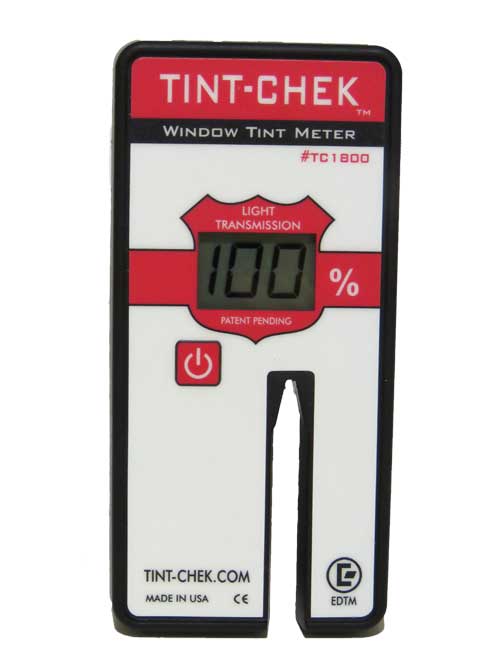
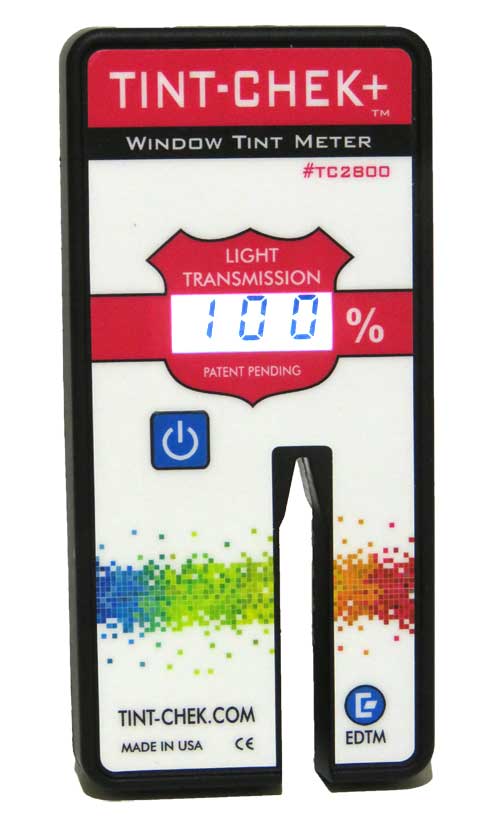
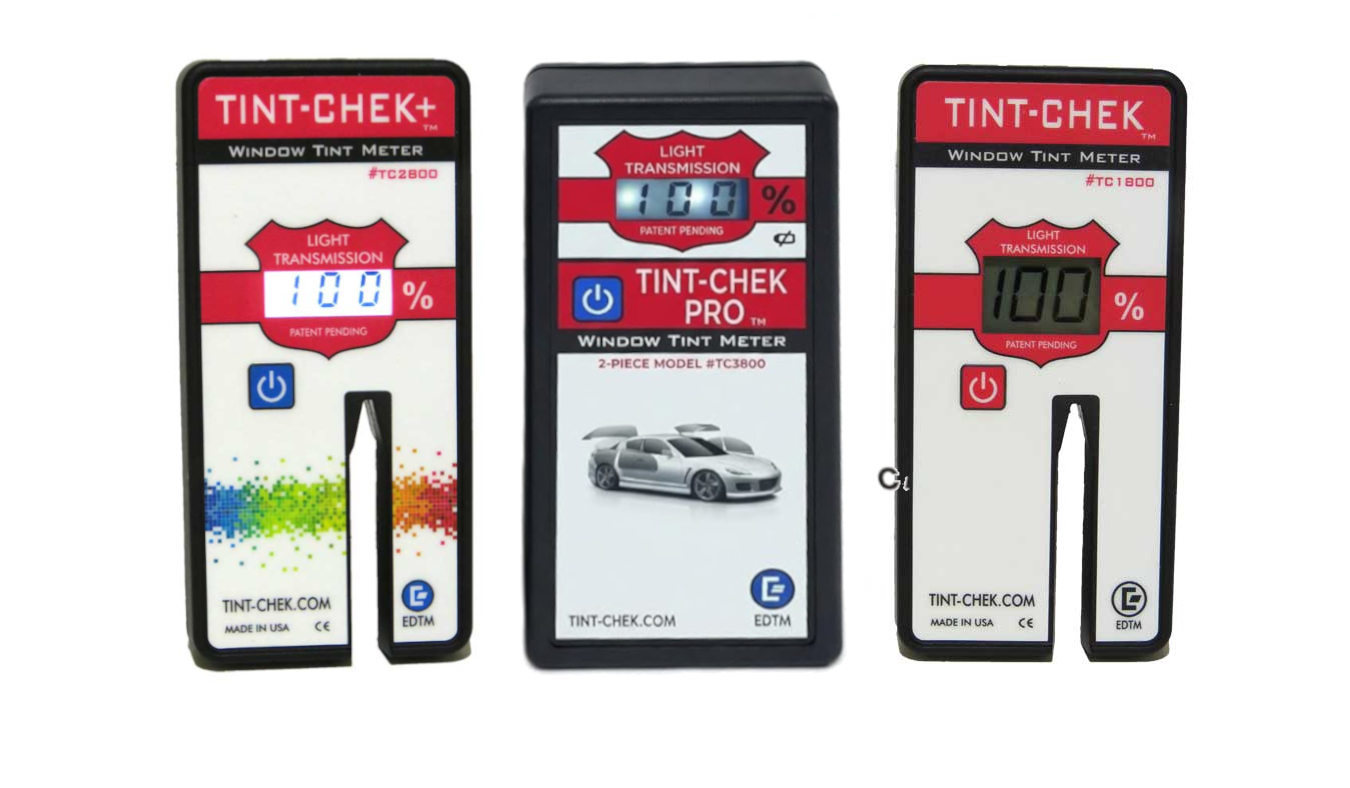
One-piece meters (TC1800 and TC2800)
The TC1800 and TC2800 are one-piece meters with a slot that slides over the edge of the glass. The manual lists these steps:
1. Roll the window down at least 3 inches.
2. Clean the glass. Fingerprints, dirt and defects on the glass can affect the reading.
3. Turn the meter on and wait for the display to read 100%. That means it is ready.
4. Slide the meter over the edge of the glass, all the way until it stops, and read the result.
5. Re-test the window to confirm your first reading.
For the most accurate result, hold the glass perpendicular to the sensor and do not tilt the meter or the glass. Be careful near the edge of a window where film may not cover the full pane. Sliding the meter fully onto the glass avoids that problem.
Two-piece meter (TC3800)
Windshields and rear windows cannot be rolled down, so they need a two-piece design. The tint gauge known as the Tint-Chek PRO uses a reflector unit that goes on the inside of the glass and an instrument unit that goes on the outside. Magnets help align the two halves. The manual lists these steps:
1. Clean the window area being tested.
2. Put both units together back-to-back, with no glass between them, and turn the power on.
3. Wait for the display to show 100%, then pull the two halves apart.
4. Place the reflector unit on the inside of the window and push it firmly so the suction cups hold it in place.
5. Place the instrument unit on the outside of the window, using the magnets to align it.
6. Press and release the power switch to see the VLT value.
7. Remove the instrument from the window. It powers off on its own.
On a rear window, defrost lines can stop the suction cups from sticking. If both cups cannot miss the lines, rotate the reflector unit 90 degrees so the cups sit between the lines.
What Is the Tolerance of a Tint Meter?
Every measuring instrument has a tolerance, the range within which its reading can differ from the true value. For Tint-Chek meters, the published accuracy is +/- 2 percentage points, and the repeatability is 1 percentage point.
As an illustration of what that means, a reading of 35% on a meter with +/- 2 percentage point accuracy corresponds to a true value somewhere between 33% and 37%. How a reading is applied against a legal limit is decided by each jurisdiction or agency, so check the procedure that applies where you work.
Accuracy vs. resolution
These two terms are often confused. Accuracy is how close the reading is to the true value. Resolution is how finely the display shows the number. All tint meters read accurately to +/- 2%. What changes between models is the display. The TC1800 shows whole percentages (1% resolution). The TC2800 and the TC3800 show results to the nearest 0.1%, so a window at 39.5% shows as 39.5% instead of being rounded to 40%. The finer display shows more detail in the number, but the accuracy stays at +/- 2 percentage points on every model.
How Do You Check That a Tint Meter Is Still Accurate?
Two light transmission standards come with each Tint-Chek meter. They have VLT values of approximately 27% and 59%, and the actual calibrated value is printed on each one. They were created using a NIST traceable source. NIST is the National Institute of Standards and Technology, the standards agency of the U.S. government.
To verify a meter, measure the standards the same way you would test a real window, and confirm the meter reads within +/- 2% of the indicated values. Before you do:
• Make sure the standards are clean and not scratched.
• Blow off any dust and remove fingerprints with a cloth (micro-fiber for the TC3800, lint-free for the TC1800 and TC2800).
• Store the standards in their re-sealable bag, inside the carrying case, when not in use.
If a reading falls outside the +/- 2% range on the TC3800, inspect the reflector area for dirt, blow off the back of the instrument unit with compressed air, and contact the manufacturer if the problem continues. On the TC1800 and TC2800, inspect the standards, and if they are in good condition, stop using the meter until calibration can be verified or corrected. Replacement standards are available as TC1810 for the TC1800 and TC2800, and TC3811 for the TC3800.
What Standards Apply to Window Tint Measurement?
There is no single tint rule that applies everywhere. VLT limits are set by each jurisdiction, and they can differ by window position and vehicle type. What stays consistent is the unit (VLT as a percentage) and the need for a traceable, verifiable measurement. For EDTM meters, that traceability comes from factory calibration to a NIST traceable standard and the included standards for regular checks.
EDTM lists the TC1800 and TC2800 as approved for law enforcement, and the TC3800 as approved for law enforcement and inspection stations. Always confirm what your own agency or inspection program requires before choosing equipment.
Common Mistakes That Affect Tint Readings
• Testing dirty glass. Dust and smudges change how much light reaches the sensor.
• Starting the meter with glass in the slot. A one-piece meter will calibrate to 100% with the glass in place. Remove it and restart with the slot empty.
• Tilting the meter or the glass instead of holding it perpendicular.
• Testing at the extreme edge of a window, where film may not reach.
• Skipping the re-test. Both manuals recommend confirming a first reading with a second one.
• Letting the reflector get dirty on a two-piece meter. Keep it clean with compressed air or a micro-fiber cloth.
Which Meter Fits Your Testing Needs?
|
Spec |
TC1800 Tint-Chek |
TC2800 Tint-Chek + |
TC3800 Tint-Chek PRO |
|
Design |
One-piece |
One-piece |
Two-piece (reflector + instrument) |
|
Accuracy |
+/- 2 percentage points |
+/- 2 percentage points |
+/- 2 percentage points |
|
Repeatability |
1 percentage point |
1 percentage point |
1 percentage point |
|
Display resolution |
1% |
0.1% |
0.1% |
|
Wavelength |
550 nm |
550 nm |
550 nm |
|
Measurement range |
0 to 100% VLT |
0 to 100% VLT |
0 to 100% VLT |
|
Max sample thickness |
0.25 in (6.5 mm) |
0.25 in (6.5 mm) |
0.25 in (6.5 mm) |
|
Min sample size |
1 in x 1/2 in (25 x 13 mm) |
1 in x 1/2 in (25 x 13 mm) |
1 in x 1 in (25 x 25 mm) |
|
Backlit display |
No |
Yes |
Yes |
|
Windshield / rear window testing |
Side windows that roll down |
Side windows that roll down |
Yes (two-piece design) |
Specifications are taken from the TC1800, TC2800 and TC3800 user manuals.
If you only test side windows that roll down, the one-piece TC1800 and TC2800 are built for that. If you also need to test windshields and rear windows, the two-piece TC3800 is designed for it. You can compare all three on the window tint meter category page.
Other Ways Tint and Glass Light Performance Are Measured
A VLT meter reports one number: visible light transmission. EDTM also makes a Solar Spectrum Transmission Meter (Model SS2450) for full spectrum measurements. It calculates values to three standards and reports Tuv, Tvis, Tsolar, Tir and Tdw. That is a different job than checking whether a window meets a VLT limit.
Frequently Asked Questions
What does VLT mean on a window tint meter?
VLT is Visible Light Transmission, the percentage of visible light that passes through the glass and film. A reading of 35% means 35% of visible light gets through.
How accurate is a window tint meter?
All Tint-Chek meters are accurate to +/- 2 percentage points, with 1 percentage point repeatability. The TC2800 and TC3800 display to the nearest 0.1%, but that finer display does not change the +/- 2 percentage point accuracy.
Can a tint meter test a windshield?
The one-piece TC1800 and TC2800 slide over the edge of glass that has been rolled down. The two-piece TC3800 can test the windshield, the rear window and the side windows.
How do I know if my tint meter needs to be checked?
Measure the two included calibration standards, about 27% and 59% VLT, and confirm the meter reads within +/- 2% of the values printed on them. The manuals recommend doing this regularly.
Why does my meter show 100% at start-up?
The meter sets its own 100% reference when it turns on. On the one-piece models, wait for 100% to appear before sliding the meter onto the glass. On the TC3800, the two halves are held together with no glass between them at start-up.
What does a tint meter error mean?
On the one-piece TC1800 and TC2800, "-E" means something is blocking the path between the LED and the sensor, or the meter was turned on with glass in the slot. On the TC3800, E1 and E2 usually point to alignment problems, and E3 means the start-up reference was different than expected. The usual fixes are proper alignment with no glass in between, and a clean reflector lens.
What is the maximum glass thickness a Tint-Chek can measure?
0.25 inches (6.5 mm), including any film.