
Knowledge Center
The Complete Guide to Window Tint Meters: Types, Technology, Standards, and Use Cases
A window tint meter is a handheld instrument that measures visible light transmission (VLT), the percentage of visible light that passes through a window and any film on it. It is used to check whether automotive tint meets a required level, in the field or in the shop.
What is a window tint meter?
A tint meter gives a number for how dark a window is. Instead of judging tint by eye, the user gets a VLT reading to compare to a required level. Tint-Chek meters from EDTM are designed for law enforcement and tinters, and they measure the VLT of automotive glass and any glass and film combination up to 1/4 inch (6.5 mm) thick.
Key terms
|
Term |
Definition |
|
VLT |
Visible light transmission, also called transmittance. The percentage of visible light that passes through glass and any film on it. |
|
Resolution |
The smallest increment a meter displays. A 0.1% meter shows 39.5%, while a meter that shows the nearest 1% may show 40%. |
|
NIST traceable calibration |
Calibration linked to a standard from the National Institute of Standards and Technology, a government standards agency. |
|
Two-piece meter |
A meter made of an instrument unit, which holds the electronics, and a reflector unit, which holds the reflector and magnets that align the two pieces. |
How does a tint meter measure VLT?
A tint meter works by shining a beam of light through the window to an optical sensor. The light source is typically around 550 nanometers. The darker the glass and film, the less light reaches the sensor. The meter converts the amount of light received into a VLT percentage on a scale from 0 to 100%.
Because the beam passes through everything between the meter's two sides, the reading covers the glass and any film together, not the film alone.
Outside conditions can interfere with the beam. Stray headlights and cloud cover have been known to affect older VLT meters, so Tint-Chek meters use patent-pending techniques to remove changing ambient light from the reading.
What types of tint meters are there?
|
Type |
How it works |
Where it fits |
|
One-piece (slot) meter |
The glass slides into an opening in the meter, and the reading appears within seconds. |
Windows where the meter can slide over the edge of the glass. Tint-Chek TC1800 and TC2800. |
|
Two-piece meter |
An instrument unit and a reflector unit sit on either side of the glass, aligned by magnets. |
Windshields, rear windows, and side windows. Tint-Chek TC3800. |
|
Multi-function instrument |
Some instruments also report visible light reflectance or UV and infrared figures in addition to VLT. |
When readings beyond VLT are needed. |
Build also matters. Some tint meters use a lever switch that activates when the meter is pushed against the glass. Tint-Chek meters are designed with no moving parts, so the glass can be slid in from any direction without risk of damaging a switch or scratching the glass.
What should you look for in a tint meter?
|
Feature |
Why it matters |
Tint-Chek |
|
Backlit display |
Makes readings easy to see in the evening, on overcast days, and indoors. |
TC2800 and TC3800 |
|
0.1% resolution |
Shows the reading in finer steps, such as 39.5% instead of 40%. |
TC2800 and TC3800 |
|
Ambient light handling |
Keeps stray headlights and cloud cover from changing the reading. |
All models |
|
NIST traceable calibration |
Ties the meter's calibration to a NIST traceable standard. |
All models, with two NIST traceable standards included |
|
No lever switch |
Nothing to break, and no risk of scratching the glass. |
TC1800 and TC2800 |
|
Windshield and rear window testing |
Needed when more than side windows are checked. |
TC3800 |
|
Battery access |
Replacing the battery without opening the unit protects the calibration. |
TC3800 slide-out battery cover |
What standards matter when measuring tint?
Tint-Chek meters come from the factory calibrated to a NIST traceable standard, and each model includes two NIST traceable calibration standards.
How do the Tint-Chek models compare?
|
Spec |
TC1800 |
TC2800 |
TC3800 |
|
Model name |
Tint-Chek |
Tint-Chek + |
Tint-Chek PRO |
|
Design |
One-piece, glass slides into the opening |
One-piece, glass slides into the opening |
Two-piece: instrument unit and reflector unit |
|
Measures |
VLT of glass and glass/film up to 1/4 in (6.5 mm) |
VLT of glass and glass/film up to 1/4 in (6.5 mm) |
VLT of glass and glass/film up to 1/4 in (6.5 mm) |
|
Backlit display |
No |
Yes |
Yes |
|
Display resolution |
Not shown |
Nearest 0.1% |
Nearest 0.1% |
|
Size |
5 x 2.5 x 1 in |
5 x 2.5 x 1 in |
5.1 x 2.6 x 2.0 in |
|
Power |
9-volt battery |
9-volt alkaline battery |
9-volt alkaline battery |
|
Calibration |
Factory calibrated, NIST traceable |
Factory calibrated, NIST traceable |
Factory calibrated, NIST traceable |
|
Included |
Carrying case, two NIST traceable calibration standards, 9-volt battery |
Carrying case, two NIST traceable calibration standards, 9-volt battery |
Carrying case, two NIST traceable calibration standards, 9-volt battery |
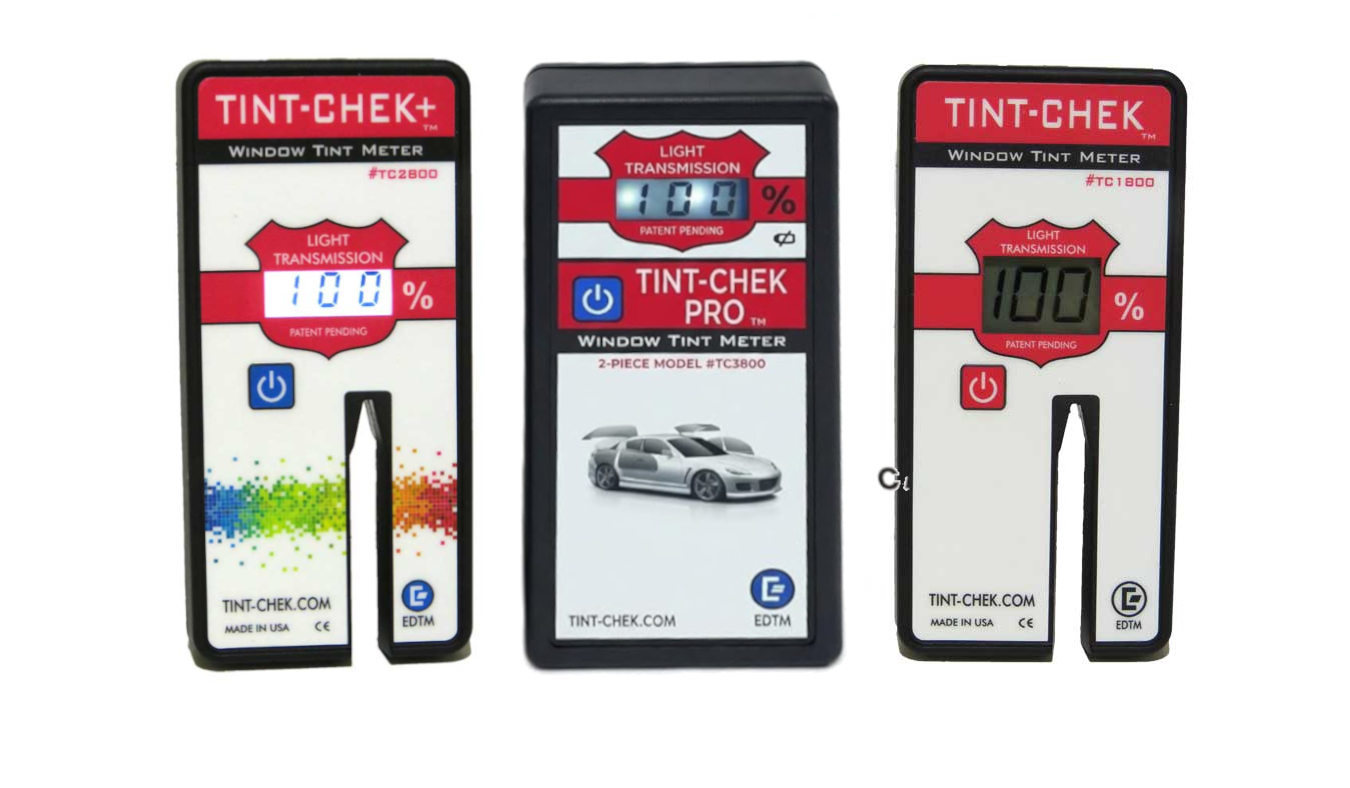
The window tint meter in the line is the TC1800. It is the compact model, thin enough to fit in a shirt pocket, and it can slip around the tight edges of a car window that does not open far.
The TC2800 is a digital tint meter that adds a backlit LCD display and a finer 0.1% display resolution to the TC1800's design.
The TC3800 PRO is a two-piece car tint meter for windshield, rear window, and side window testing. It is designed for law enforcement, police, and tinters.
Who uses tint meters?
|
User |
Why they measure tint |
|
Law enforcement and police |
To check on the spot whether tint on a vehicle is legal, using a reading instead of an estimate by eye. |
|
Tinters and installers |
To verify the VLT of a window after film is applied. |
|
Inspection shops and auto shops |
To test automotive glass in the shop against the required level. |
Frequently asked questions
What does VLT mean?
VLT stands for visible light transmission, also called transmittance. It is the percentage of visible light that passes through the glass and any film on it. A reading of 0% means no light passes through, and 100% means all light passes through.
How does a tint meter measure VLT?
A tint meter sends a beam of light through the window to an optical sensor. The darker the window, the less light reaches the sensor, and the meter converts that into a VLT percentage.
What is the difference between a one-piece and a two-piece tint meter?
A one-piece meter, like the TC1800 and TC2800, has an opening that the glass slides into. A two-piece meter, like the TC3800, has a reflector unit and an instrument unit, and it can test windshield, rear window, and side window tint.
How thick a window can a tint meter measure?
Tint-Chek meters measure glass and any glass and film combination up to 1/4 inch (6.5 mm) thick.
Can a tint meter be used at night?
Yes, with a backlit display. The TC2800 and TC3800 have a backlit LCD, which helps in the evening, on overcast days, and indoors.
What does 0.1% resolution mean?
Resolution is how finely the meter displays a reading. A meter that shows the nearest 1% might show a window at 39.5% VLT as 40%, while the TC2800 and TC3800 show 39.5%.
What does NIST traceable calibration mean?
NIST is the National Institute of Standards and Technology, a government standards agency. Tint-Chek meters come from the factory calibrated to a NIST traceable standard.
Do stray headlights or cloud cover affect the reading?
Changing ambient light has been known to affect older VLT meters. Tint-Chek meters use patent-pending techniques to remove ambient light conditions that change in the testing environment.
What comes with a Tint-Chek meter?
Each model includes a protective carrying case, two NIST traceable calibration standards, and a 9-volt battery, so it is ready to use out of the box.