
Knowledge Center
Tint Meter vs. Tint Gauge vs. Tint Tester: What's the Difference?
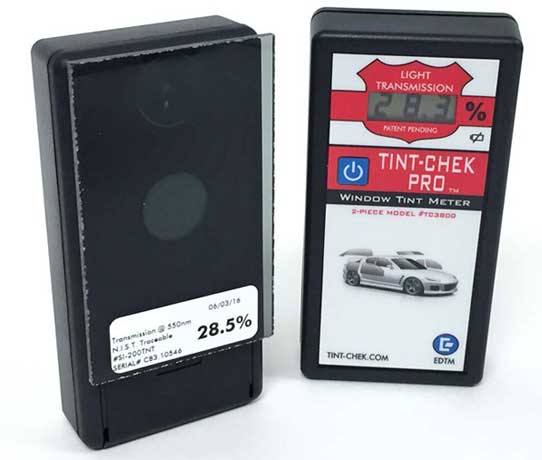
If you're shopping for a way to check window tint darkness, you'll run into three terms: tint meter, tint gauge, and tint tester. It's easy to assume they're three different tools.
In most cases, they're the same tool. All three describe a handheld device that measures how much visible light passes through a window. "Window tint meter" is the most common name in the industry, so that's the term this guide uses.
Below, we explain where each name comes from, how a window tint meter works, and how to choose between one-piece and two-piece models.
What Is a Window Tint Meter?
A window tint meter measures Visible Light Transmittance (VLT), the percentage of visible light that passes through a window and any film applied to it.
• A lower VLT percentage means a darker window.
• A higher VLT percentage means a lighter window.
Tint laws are written as VLT percentages, so a tint meter is the standard way to answer the question, "Is the tint legal?" Law enforcement officers use window tint meters in the field, and tinters and inspection shops use them to verify work and compliance.
Tint Meter vs. Tint Gauge vs. Tint Tester
Tint Meter
"Tint meter" is the most widely used name. It describes what the device does: it meters, or measures, light transmission. You'll also see it called a window tint meter or VLT meter.
Tint Gauge
"Tint gauge" is a common alternate name for the same device. People often use "gauge" for any tool that gives a numeric reading, so a tint gauge that displays a VLT percentage is simply a tint meter.
One caution: "gauge" can also refer to a tool that measures window film thickness. That tool won't tell you how dark a window is or whether the tint is legal. If your goal is checking tint compliance, make sure the product measures VLT.
Tint Tester
"Tint tester" is a casual name for a tint meter. It's popular with vehicle owners and buyers who want to test a window's tint level. The purpose is the same: test the glass and read the VLT percentage.
Quick Comparison
|
Term |
What It Usually Means |
Measures VLT? |
|
Tint meter |
Handheld device that measures VLT |
Yes |
|
Tint gauge |
Alternate name for a tint meter (occasionally a film thickness gauge) |
Usually; verify |
|
Tint tester |
Casual name for a tint meter |
Yes |
|
Digital tint meter |
A tint meter with an electronic display |
Yes |
What Is a Digital Tint Meter?
A digital tint meter is a tint meter that shows its result as a number on an electronic display. Modern professional meters are digital, so "digital tint meter" and "window tint meter" describe the same category in practice.
Digital meters make results easy to read and remove guesswork. EDTM's Tint-Chek meters use all-digital, microprocessor-controlled electronics that take high-speed measurements on a real-time display. The reading locks on one result instead of drifting.
How Does a Window Tint Meter Work?
The basic process is simple:
1. The meter measures how much visible light passes through the glass.
2. The glass, along with any film on it, sits between the meter's light source and sensor.
3. The meter displays the result as a VLT percentage.
Because the reading is taken through the entire window, it reflects the glass and film together, not the film alone. EDTM's Tint-Chek meters measure automotive glass and any glass or film up to 1/4" (6.5 mm) thick.
Why Ambient Light Matters
Changing light conditions can affect a reading. Stray headlights and cloud cover are known to impact older VLT meters. The Tint-Chek line uses patent-pending techniques to remove changing ambient light from the measurement, so you can test in the field or the shop with more confidence.
One-Piece vs. Two-Piece Tint Meters
One-piece meters are compact and simple. You slide the window glass into the opening in the meter. They're ideal for side windows that roll down.
Two-piece meters separate the meter into two enclosures that sit on opposite sides of the glass. This allows testing of windshields and rear windows, as well as side windows.
Which Tint-Chek Window Tint Meter Is Right for You?
EDTM's Tint-Chek line is designed for law enforcement, police, and tinters, and every model is made in the USA. All three share these features:
• Measures VLT of automotive glass and any glass/film up to 1/4" (6.5 mm) thick
• Factory calibrated to a NIST-traceable standard
• No mechanical lever switches (see below)
• Patent-pending ambient light removal
• Automatic shut-off after several minutes of non-use to conserve battery
• Includes a protective carrying case, two NIST-traceable calibration standards, and a 9-volt battery
TC1800 Tint-Chek Window Tint Meter
The TC1800 Tint-Chek Window Tint Meter is a one-piece meter built for law enforcement, police, and tinters.
• Compact size: 5" x 2.5" x 1", thin enough to fit in a shirt pocket and to slip around the tight edges of a window that doesn't open far.
• Larger display: a display 35% larger than competing models, for easier reading.
• No moving parts: slide the glass into the opening in any direction without worrying about damaging a lever switch or scratching the glass.
TC2800 Tint-Chek + Window Tint Meter
The TC2800 Tint-Chek + Window Tint Meter is a one-piece meter with upgrades over the TC1800:
• Backlit LCD display: helpful in the evening, on overcast days, or indoors, so windows can be tested at any time of day.
• Increased resolution: readings to the nearest 0.1%, which removes the rounding errors of lower-cost models. For example, a window at 39.5% VLT could be rounded up to 40% by a meter that only displays whole numbers. That difference matters when a window sits right at the legal limit.
TC3800 Tint-Chek PRO Window Tint Meter (Two-Piece)
The TC3800 Tint-Chek PRO Window Tint Meter is EDTM's two-piece tint meter and is labeled the industry standard.
• Two-piece design: tests windshield, rear window, and side window tint. The Reflector Unit has no electronics and houses the reflector and magnets that help align the two enclosures. The Instrument Unit contains all of the electronics.
• Backlit LCD display and 0.1% resolution: same as the TC2800.
• Simple operation: push the power button, place the meter on the window, and press the power button again to get the result.
• Hand-friendly size: 5.1" x 2.6" x 2.0", designed for one-handed use.
• Easy battery replacement: a slide-out battery cover keeps you away from the electronics and calibration. No screws to remove.
At-a-Glance Comparison
|
Feature |
TC1800 |
TC2800 |
TC3800 |
|
Design |
One-piece |
One-piece |
Two-piece |
|
Tests side windows |
Yes |
Yes |
Yes |
|
Tests windshield and rear window |
No |
No |
Yes |
|
Backlit LCD display |
No |
Yes |
Yes |
|
Resolution |
Standard |
0.1% |
0.1% |
|
NIST-traceable calibration |
Yes |
Yes |
Yes |
|
No mechanical lever switch |
Yes |
Yes |
Yes |
Note: "Standard" resolution isn't specified on the TC1800 page. If you know the exact resolution, replace it in the table.
You can compare every model on our automotive tint meters page.
Why "No Mechanical Lever Switch" Matters
Some tint meters use a lever switch that activates the meter when it's pushed against the glass. Lever switches are moving parts that can wear out or get damaged, and they can scratch the glass being tested. Tint-Chek meters have no moving parts for this purpose, which supports reliability and durability.
How to Choose a Window Tint Meter
• Which windows will you test? For side windows, a one-piece meter such as the TC1800 or TC2800 may be enough. For windshields and rear windows, choose the two-piece TC3800.
• Where will you test? If you work in the evening, indoors, or on overcast days, a backlit display (TC2800 or TC3800) helps.
• How precise do you need to be? Readings to the nearest 0.1% help when a window is close to the legal limit.
• How portable should it be? All models are compact, and the TC1800 and TC2800 fit in a shirt pocket.
• Is it calibrated? Choose a meter that ships calibrated to a NIST-traceable standard and includes calibration standards so you can verify it.
Tips for Accurate Tint Readings
• Clean the glass so dirt or residue doesn't interfere with the reading.
• Take more than one reading across the window to confirm consistency.
• Verify with the calibration standards that come with your meter.
• Know the local limit. Legal VLT limits vary by location and by window position, so check the rules where the vehicle is registered.
Frequently Asked Questions
Is a tint meter the same as a tint gauge?
In most cases, yes. Both terms usually describe a device that measures VLT. Confirm that a "gauge" reads light transmission, since some gauges measure film thickness instead.
Is a tint tester the same as a tint meter?
Yes. "Tint tester" is a casual name for a window tint meter.
What does VLT mean?
VLT stands for Visible Light Transmittance, the percentage of visible light that passes through a window and its film. Lower numbers mean darker tint.
Can a tint meter measure a windshield?
A two-piece meter such as the TC3800 can test windshield, rear window, and side window tint. One-piece meters like the TC1800 and TC2800 are designed for windows where the glass slides into the opening.
How thick a glass can a Tint-Chek measure?
Tint-Chek meters measure automotive glass and any glass or film up to 1/4" (6.5 mm) thick.
Can I use a tint meter at night?
Yes, with a backlit model. The TC2800 and TC3800 have backlit LCD displays that make readings easy to see in dark conditions.
Does a tint meter come calibrated?
Tint-Chek meters come from the factory calibrated to a NIST-traceable standard, and each includes two NIST-traceable calibration standards.
Who uses window tint meters?
Law enforcement officers, police, professional tinters, and inspection and auto shops use them to check whether tint is legal.
Ready to Pick a Tint Meter?
Tint meter, tint gauge, tint tester, digital tint meter: the names differ, but the job is the same. Each reads VLT so you can tell whether a window's tint is within the legal limit. What matters is choosing the right type of window tint meter for your work.
Browse EDTM's automotive tint meters and compare the TC1800, TC2800, and TC3800 to find the right fit.