
Knowledge Center
What Is a Good VLT Reading for Car Window Tint?
Short answer: There is no single good VLT reading. The right number depends on your local tint law, which differs by location and often by window position, and on what you want from the film. A tint meter to check VLT tells you what the finished window measures so you can compare it to the rule that applies.
What VLT means
VLT stands for visible light transmission, the percentage of visible light that passes through the glass and film. A higher number means more light gets through, and a lower number means a darker window.
How to decide what is "good"
1. Check your local law. Limits often differ by window position. Look up the official rule for your location.
2. Measure the finished window. The film's rating is not the final number, because the glass is part of the stack.
3. Consider your needs. Visibility at night, privacy, glare, and appearance all matter.
How to measure VLT
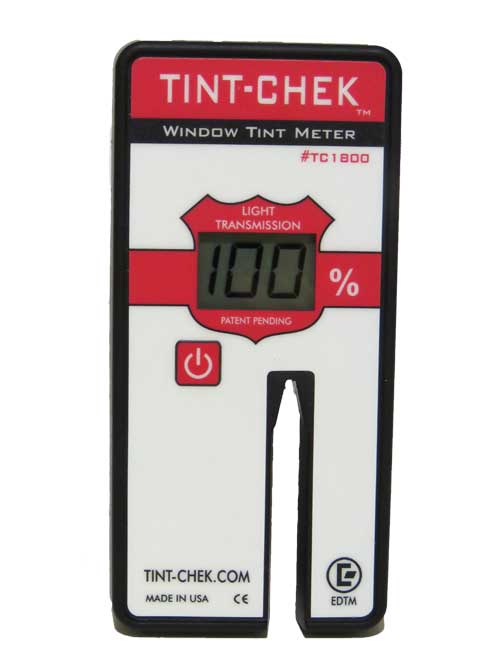
Use a tint meter. The TC1800 and TC2800 horseshoe models fit over lowered side glass, and the TC3800 two-piece meter handles windshields and rear windows. The TC1800 Tint-Chek is the entry model in EDTM's range.
Not sure which term to use? See tint meter vs. tint gauge vs. tint tester.
Tips for an accurate reading
• Clean the glass first.
• Take more than one reading.
• Use a meter whose thickness range covers the glass and film. EDTM lists up to 1/4 inch (6.5 mm).
Frequently asked questions
Is a lower VLT number darker?
Yes.
Does VLT include the glass?
Yes. A meter reads the glass and film together.
Where can I find my legal limit?
Check your state or national motor vehicle regulations or your local agency.