
Knowledge Center
How Do You Measure Air Space in an IGU Without Disassembling It?
Short answer: use a glass thickness measuring tool that reads a sealed insulated glass unit (IGU) in place. EDTM’s Glass-Chek PRO and ELITE report air space thickness along with each pane of glass and the overall unit thickness, so there is no need to open or remove the unit.
Key Takeaways
• An IGU is a sealed unit, so the air space cannot be measured directly without damaging it.
• A glass thickness meter reads glass, air space, and overall thickness from outside the unit.
• Measure at the bottom center of the window for the most accurate and repeatable result.
• The same measurement works on double and triple pane units, installed or in production.
This article is about air space thickness specifically. For the full measurement method across glass, air space, and overall thickness, see how to measure the thickness of double-pane glass.
Why You Should Not Disassemble an IGU
An insulated glass unit is built as a sealed assembly. Taking it apart to measure the gap would ruin it, and on an installed window it would mean removing the unit entirely. That is why the question of how do you measure air space in an IGU has a practical answer in non-destructive measurement.
How a Meter Measures Air Space in Place
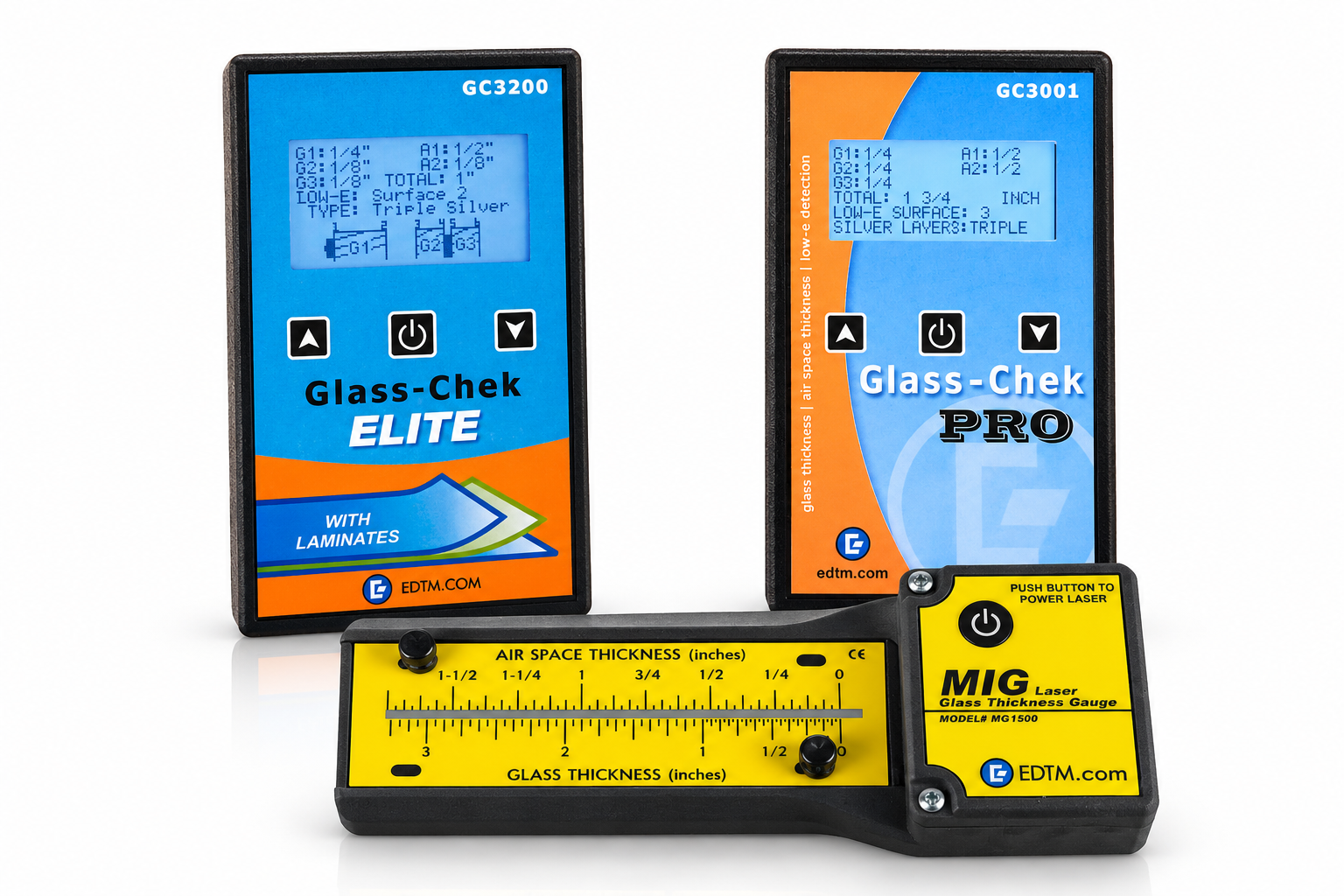
A glass thickness measuring tool such as the Glass-Chek PRO measures the thickness of each pane of glass, the air space, and the overall IG thickness of double and triple pane windows. EDTM describes an improved, higher-precision laser in the GC3001 for more accurate readings, and a thickness range of approximately 2 inches. The Glass-Chek ELITE adds laminate thickness to the readout and a graphical display that draws the window approximately to scale.
Step-by-Step
1. Confirm the operating mode and units on the meter before you start.
2. Place the meter at the bottom center of the window.
3. Take the measurement with a single push of the button.
4. Step through the screens and note the air space value, each glass thickness, and the overall thickness.
5. Record everything on the work order, plus any Low-E result.
What the Air Space Reading Is Used For
• Replacement orders. The air space is part of the specification of the new unit.
• Production checks. Spot-checks confirm the unit was built as specified.
• Inspection. Inspectors document the construction of installed windows.
• Triple pane windows. Each air space is shown alongside every pane in a single push.
Tips for a Good Reading
• Measure at the bottom center, the location EDTM recommends.
• Check that the meter’s mode and units match the job.
• Record the result at the window instead of from memory.
• If a reading looks wrong, re-measure at the same location before ordering.
IGU, IG Unit, and MIG: Quick Terms
IGU and IG unit both refer to an insulated glass unit, a sealed assembly of two or more panes separated by an air space. EDTM also offers the MIG thickness gauge. Check its product page for what it measures and how it fits your work.
What Changes From Single to Double to Triple Pane
|
Construction |
Readings you need |
|
Single pane |
Glass thickness |
|
Double pane IGU |
Two panes, one air space, overall thickness |
|
Triple pane IGU |
Three panes, two air spaces, overall thickness |
|
Laminated or Low-E units |
Add laminate and coating information (the ELITE shows laminate thickness) |
Common Mistakes When Measuring Air Space
• Trusting the overall thickness and assuming the air space from memory
• Measuring at a spot other than the bottom center
• Forgetting that triple pane units have two air spaces
• Not recording the reading until later
• Ignoring the Low-E result that determines the coating on the replacement
A Quick Record Template
|
Field |
Entry |
|
Unit location |
|
|
Pane 1 / air space 1 / pane 2 |
|
|
Air space 2 / pane 3 (if triple) |
|
|
Overall IG thickness |
|
|
Low-E type and surface |
|
|
Date and measured by |
|
Air Space Thickness vs. Gas Fill: Two Different Measurements
People sometimes search for air space and mean gas content. They are separate measurements. A thickness meter reports how wide the space is. The amount of insulating gas, such as argon, inside the unit is measured by other instruments. Some gas methods are invasive and pierce the seal, which damages the unit, while non-invasive methods exist that do not. If gas content matters to your work, treat it as a separate test and do not expect a thickness meter to report it.
Frequently Asked Questions
Can I measure the air space in a window that is already installed?
Yes. EDTM lists testing windows already installed in the field among the Glass-Chek PRO’s applications.
Does it work on triple pane windows?
Yes. It shows glass, air space, and overall thickness for triple pane units in one push.
Does the meter show Low-E coatings?
Yes. The Glass-Chek PRO detects Low-E coatings and shows hard or soft coat and, for soft coat, the number of silver layers.
Does it tell me what gas is inside the unit?
EDTM’s materials describe thickness and Low-E measurements. They do not describe gas fill detection.
Measure Without Breaking the Seal
Use a meter that reads through the glass, measure at the bottom center, and record every value. Explore EDTM’s glass thickness measuring tool lineup to find the model that fits your glass.