
Knowledge Center
Glass Thickness Gauge Buying Guide: How to Choose the Right Tool for Your Shop
A glassthickness gauge tells you what is actually in a window before you quote, order, or install: the thickness of each pane, the air space between them, the overall unit thickness, and in the right models, the type and location of a Low-E coating. The right gauge saves you from ordering the wrong insulated glass (IG) unit. The wrong gauge leaves you guessing on exactly the jobs where guessing is expensive.
This guide walks through what to look for, which features matter for which jobs, and how EDTM’s Glass-Chek models compare, so you can match the tool to your shop instead of buying on price alone.
Key Takeaways
• Match the gauge to the glass you measure most: single, double, or triple pane, Low-E coated, or laminated.
• For replacement ordering, prioritize Low-E type detection and a wide thickness range (approximately 2 inches on the GC3001).
• If you work with laminated glass, look at the GC3200 Glass-Chek ELITE, which identifies laminate and measures the inner layer.
• Weigh support and build quality, not only price. EDTM builds Glass-Chek meters in Toledo, Ohio.
What a Glass Thickness Gauge Does
A glass thickness gauge measures sealed glass units without taking them apart. Depending on the model, one measurement can return glass thickness, air space thickness, laminate thickness, overall IG thickness, and Low-E information. Shops use that data to order the correct replacement unit and to confirm what is already installed.
You will see the same tool called a glass thickness meter, a glass thickness measuring tool, or a glass air space thickness detector. They describe the same category.
Who Needs a Glass Thickness Gauge
• Glass replacement shops that need the exact IG unit specification before ordering.
• Window installers and service technicians who measure installed windows in the field.
• Production and quality personnel who spot-check units during manufacturing.
• Building inspectors and surveyors who need to document what glass is in a building.
7 Things to Check Before You Buy
1. Which window types you measure
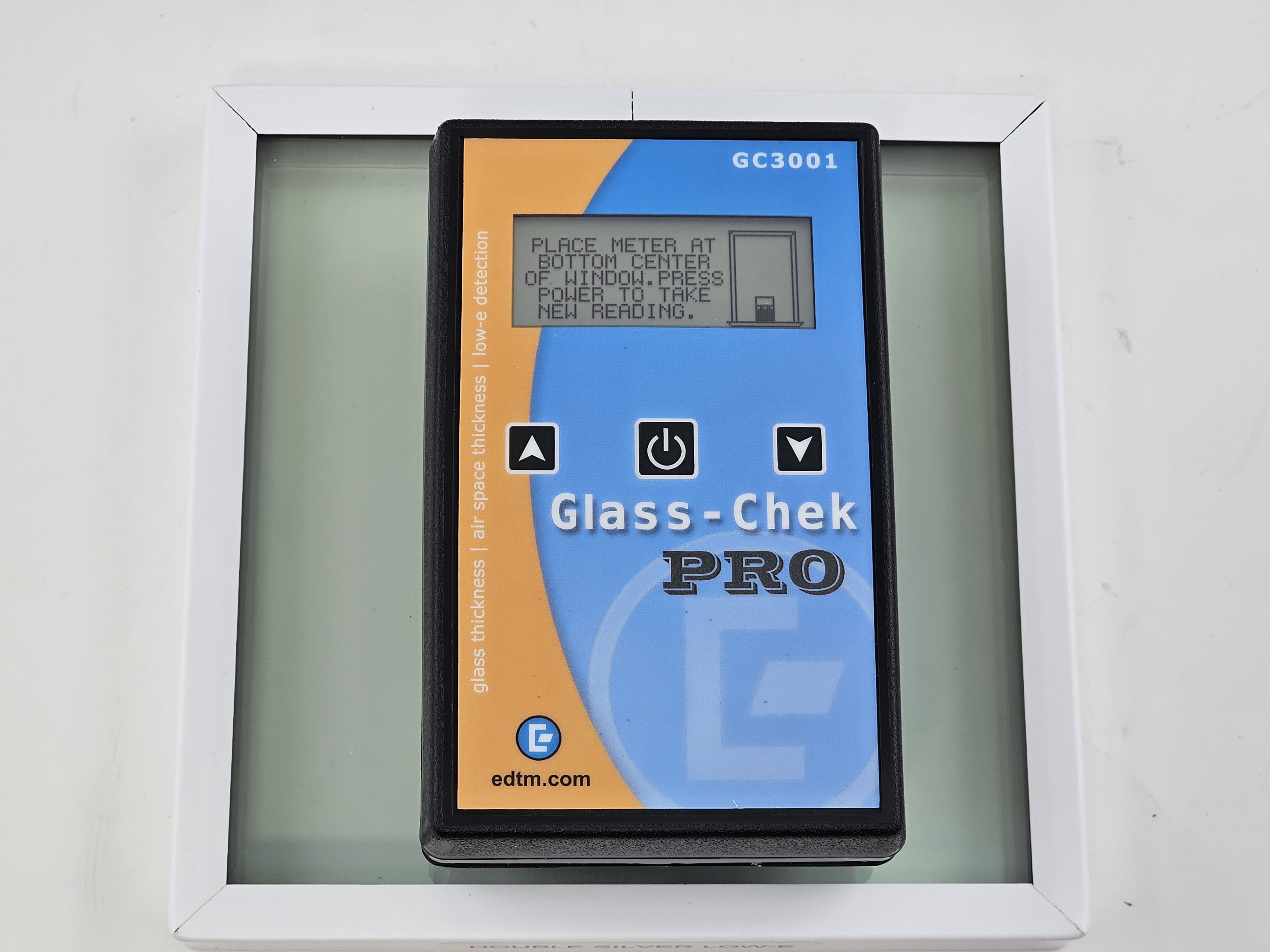
List the glass you see most. Single pane, double pane, and triple pane all need to be supported, and so does anything unusual such as tinted glass or suspended film. The EDTM Glass-Chek PRO measures glass, air space, and overall IG thickness on triple pane windows with a single push of a button.
2. Thickness range
A wider range means fewer units you cannot measure. The Glass-Chek PRO has an expanded range of approximately 2 inches, improved from 1.2 inches on earlier models, and works with residential and commercial glass.
3. Low-E detection
If you replace glass, you need to know which Low-E coating is in the unit. The wrong coating can hurt energy performance, and it can change how the window reflects light, so a replacement may not match the rest of the building. Look for a gauge that tells you whether a coating is hard coat or soft coat and, for soft coat, whether it is single, double, or triple silver. The Glass-Chek PRO does this.
4. Laminated glass
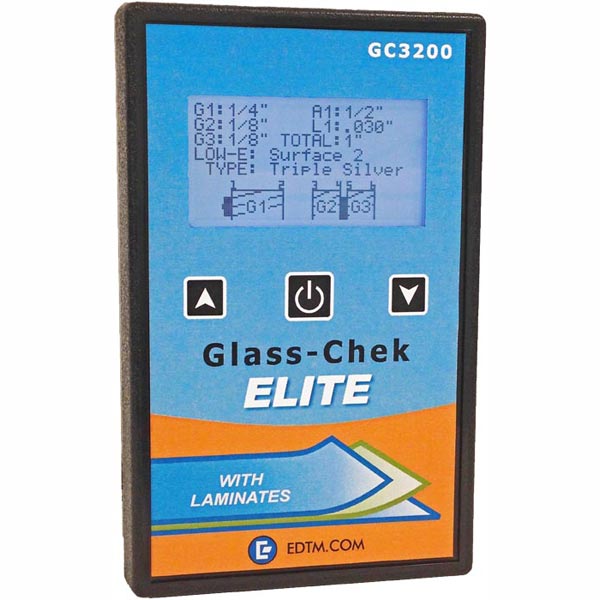
Laminated glass is a separate challenge. The Glass-Chek PRO displays total thickness of laminated glass. The newer Glass-Chek ELITE goes further: it identifies laminated glass and measures the thickness of the laminate inner layer.
5. Display and units
A clear display reduces mistakes. The GC3001 can show actual values or values rounded to ASTM standards in fractions of an inch, thousandths of an inch, decimal millimeters, and more. The Glass-Chek ELITE adds a graphical display that draws the window approximately to scale and numbers each piece of glass and surface.
6. Portability and power
A field tool has to survive a truck. The Glass-Chek PRO runs on a common 9-volt alkaline battery and ships with a protective carrying case.
7. The manufacturer behind it
Measuring tools need support. EDTM designs and builds Glass-Chek meters at its plant in Toledo, Ohio, and states that its glass testing equipment has been trusted by more than 5,000 companies worldwide over the last 25 years.
Which EDTM Glass Thickness Gauge Fits Your Shop
|
Feature |
GC3001 Glass-Chek PRO |
GC3200 Glass-Chek ELITE |
|
Glass, air space, overall IG thickness |
Yes, including triple pane |
Yes, including triple pane |
|
Low-E detection |
Yes: hard vs. soft coat, single/double/triple silver |
Yes, with Low-E display |
|
Laminated glass |
Displays total laminated thickness |
Identifies laminate and measures laminate inner layer |
|
Graphical window display |
Result screens with arrow-key control |
Graphical display drawn approximately to scale |
|
Best fit |
Glass replacement, field service, inspection |
Shops and plants that also work with laminated glass |
The GC3001Glass Chek Pro is a strong all-around choice for replacement shops. With one button push, it tells you the exact replacement IG unit to order. If laminated glass is a regular part of your work, step up to the GC3200Glass-Chek ELITE.
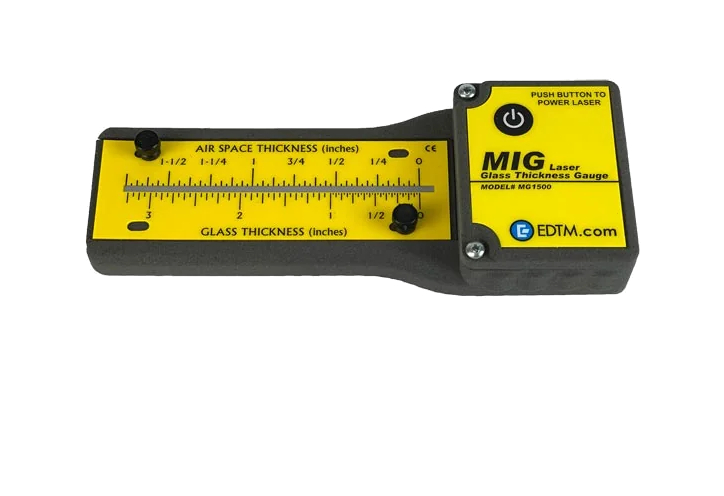
EDTM also offers the MG1500MIG thickness gauge. Review its product page against the checklist above to see whether it covers your applications.
Three Example Shop Profiles
These are illustrative profiles, not customer case studies. Use them to see which features carry the most weight for your own work.
• A replacement shop that mostly sees double-pane Low-E units. The priorities are the exact IG unit to order and the Low-E coating type. The GC3001 is built around those two needs.
• A service technician working in multi-story buildings. Access is often limited to the inside of the window, so single-side Low-E detection and portability matter most.
• A plant or specialty shop that handles laminated constructions. Identifying the laminate and measuring the inner layer is the deciding feature, which points to the GC3200 Glass-Chek ELITE.
Questions to Ask Before You Order Any Gauge
1. Which window constructions does it measure: single, double, triple pane?
2. Does it tell me whether a Low-E coating is hard coat or soft coat, and the number of silver layers?
3. Can it identify laminated glass and measure the laminate layer, or only report total thickness?
4. What is its thickness range?
5. Can I choose the units my suppliers and customers use?
6. What power does it use, and does it include a carrying case?
7. Where is it made, and who do I call if I have a technical question?
Budget Beyond the Purchase Price
The tool price is only part of the picture. Add a spare 9-volt alkaline battery, some staff time to learn the menu and measuring technique, and a record-keeping routine. Then compare that total with what one incorrectly ordered IG unit costs your business, including the return, the delay, and the return trip. Using your own numbers for wrong orders per year will tell you more than any generic estimate.
Common Buying Mistakes
• Buying on price alone. A cheaper tool that cannot detect Low-E or handle triple pane will cost you in re-orders.
• Ignoring laminated glass. If you see it even occasionally, check that your gauge can handle it.
• Skipping training. Take measurements in the bottom center of the window, which is the most accurate and repeatable location. The GC3001 shows a welcome-screen reminder for exactly this reason.
Frequently Asked Questions
What is a glass thickness gauge used for?
It is used to measure the thickness of glass panes, air space, and overall IG units so you can order correct replacements, verify production, or inspect buildings.
Can a glass thickness gauge find Low-E coatings?
Some can. The Glass-Chek PRO detects Low-E coatings, reports hard or soft coat, and classifies soft coats as single, double, or triple silver. It can locate a Low-E coating on a double-pane window from a single side.
Do I need a different gauge for triple pane windows?
Not with the right model. The Glass-Chek PRO and ELITE both measure triple pane windows in a single push.
Is it only for glass replacement?
No. EDTM lists field installation and servicing, production spot-checking, and building inspection as applications too.
Choose the Gauge That Matches Your Work
Start with the glass you measure most, then check range, Low-E detection, and laminated glass support. Explore EDTM’s full range of glass thickness gauge options, or call EDTM with questions before you buy.