
Knowledge Center
Glass Thickness Measuring Tool for Low-E and Laminated Glass: What Actually Works
Plain clear glass is easy to measure. Low-E coated glass and laminated glass are where many tools fall short. If you are replacing or inspecting windows that include either one, the right glass thickness measuring tool has to do more than report a number. It has to tell you what kind of coating is present, where it is, and how thick each layer is.
This article explains why these glass types are harder, what a capable tool needs to do, and how EDTM’s Glass-Chek models approach each case.
Key Takeaways
• For Low-E, choose a tool that identifies hard or soft coat, silver layers, and the surface the coating is on.
• For laminated glass, choose a tool that identifies the laminate and measures its inner layer: the GC3200 ELITE.
• Both Glass-Chek models measure triple pane units in one push.
• Record coating type and surface along with every thickness reading.

Why Low-E and Laminated Glass Are Harder to Measure
Low-E coatings are thin layers applied to a glass surface to improve a window’s energy performance. They are invisible to the eye, but they change how the window performs and how it reflects light. Laminated glass adds an inner layer between glass panes, which adds thickness that has to be identified and accounted for separately.
In both cases, a simple thickness reading is not enough. You need the type of coating, the surface it is on, and the thickness of each component.
What a Good Tool Needs for Low-E Glass
Identify the coating type
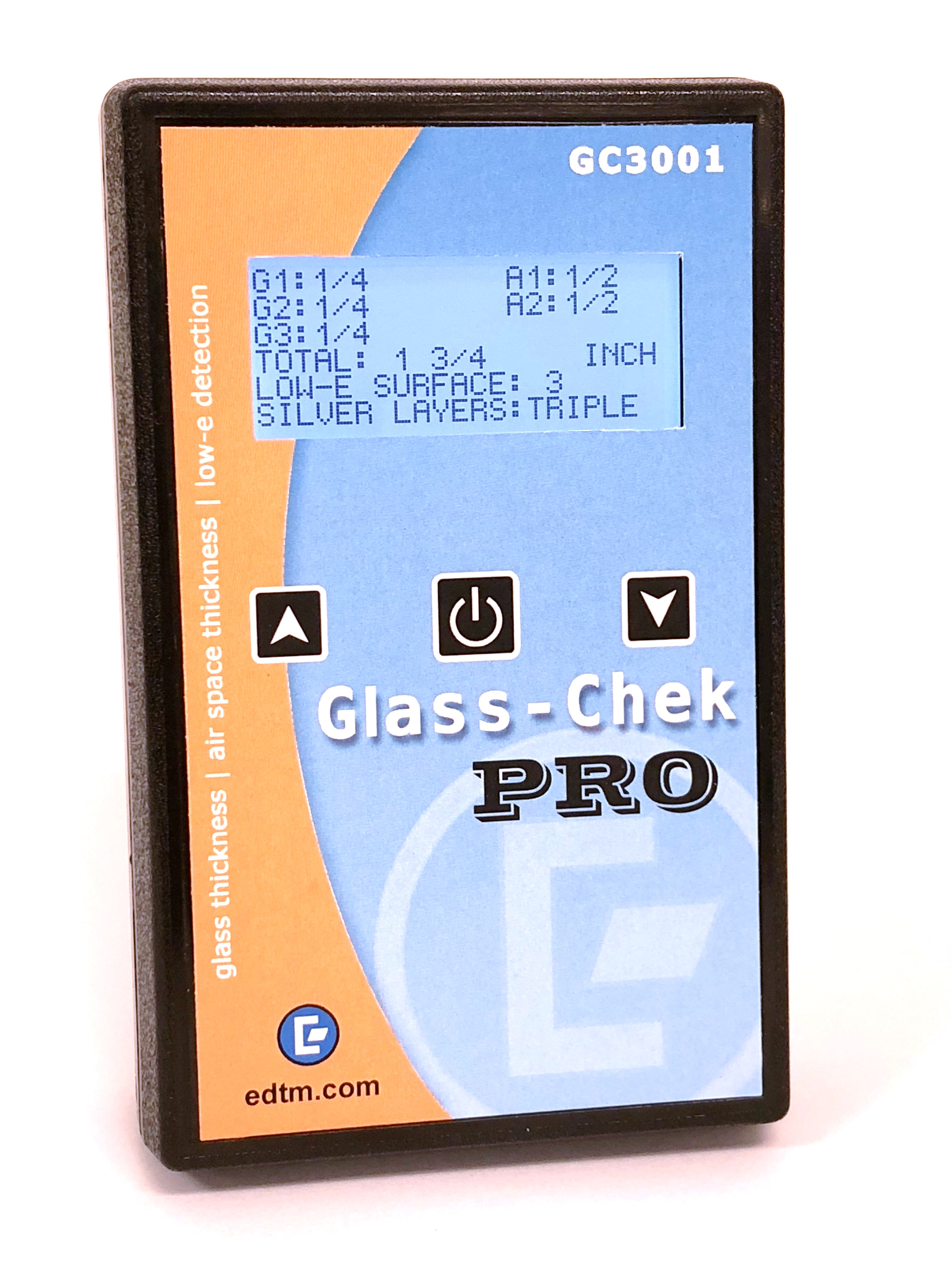
When replacing glass, you must know the type of Low-E in use. A coating that does not match the rest of the building can make the new window look noticeably different and can affect energy performance. The Glass-Chek PRO displays whether a detected coating is hard coat or soft coat, and when it finds a soft coat it classifies it as single, double, or triple silvered.
Locate the surface
Surfaces in an IG unit are numbered, so knowing the surface helps you order and orient glass correctly. The Glass-Chek PRO can locate a Low-E coating on a double-pane window from a single side. On the newer GC3001, the meter can confirm the coating is on Surface 3, which the older GC3000 could not do when the coating was on the far pane. EDTM notes this does not apply to certain window types.
Show it clearly
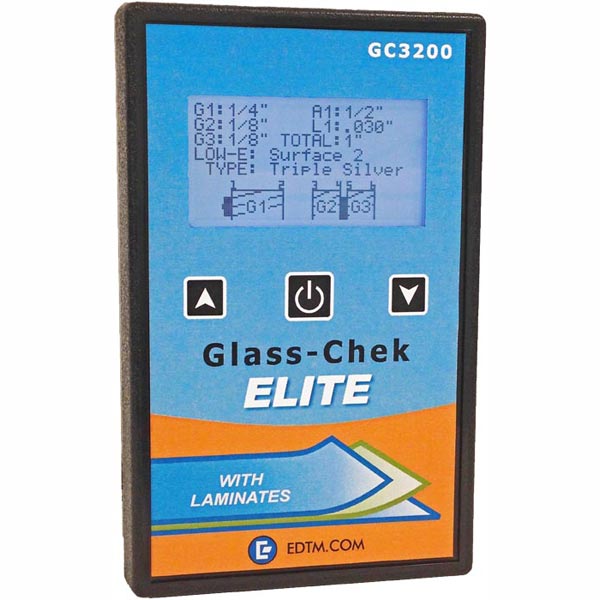
The Glass-Chek ELITE adds a graphical display that draws the window approximately to scale, assigns a number to each piece of glass and each surface, and shows Low-E location and type. That makes the makeup of the window easier to read at a glance.
What a Good Tool Needs for Laminated Glass
Laminated glass requires a tool that can recognize the laminate and measure it. The GC3200 Glass-Chek ELITE is the EDTM model designed for this. It identifies laminated glass in a window and measures the thickness of the laminate inner layer. In a special operating mode, it can also identify which piece of glass carries the Low-E coating when the Low-E surface is placed against the laminate inner layer. The display includes glass, air space, laminate, and overall thickness.
The Glass-Chek PRO displays the total thickness of laminated glass, which covers many replacement needs. If you must separate the laminate layer from the rest, step up to the ELITE.
Reading Surface Numbers on an IG Unit
Surfaces in an insulated glass unit are numbered starting from the outside. In a double-pane unit, surface 1 is the outside face of the outer pane, surface 2 is the air-space face of the outer pane, surface 3 is the air-space face of the inner pane, and surface 4 is the room-side face of the inner pane. Knowing the surface where a coating sits matters when you order replacement glass and orient it correctly.
Hard Coat and Soft Coat in Plain Terms
The Glass-Chek PRO reports whether a Low-E coating is hard coat or soft coat. EDTM’s materials identify soft coats as sputtered coatings, and the PRO goes a step further by classifying a soft coat as single, double, or triple silvered. That detail lets you match the replacement to the coating already in the building.
Pre-Order Checklist for Low-E and Laminated Units
• Measure at the bottom center of the window.
• Record the thickness of each pane and the air space.
• Record the overall unit thickness.
• Record whether the glass is laminated and, if you are using the ELITE, the laminate thickness.
• Record Low-E type (hard or soft), silver layers if soft, and surface location.
• If you know the glass manufacturer, note it: in many cases it helps identify the specific coating.
Which Tool Fits Which Job
|
Your situation |
What you need |
EDTM model to review |
|
Double or triple pane, Low-E coated, replacement order |
Thickness, air space, overall thickness, Low-E type and surface |
GC3001 Glass-Chek PRO |
|
Only inside access on a multi-story building |
Low-E detection from one side |
GC3001 Glass-Chek PRO |
|
Laminated glass identification and inner layer thickness |
Laminate detection and measurement |
GC3200 Glass-Chek ELITE |
|
Low-E glass paired with a laminate layer |
Identify which pane has the coating |
GC3200 Glass-Chek ELITE |
|
Triple pane with mixed construction |
Single-push measurement of all layers |
GC3001 or GC3200 |
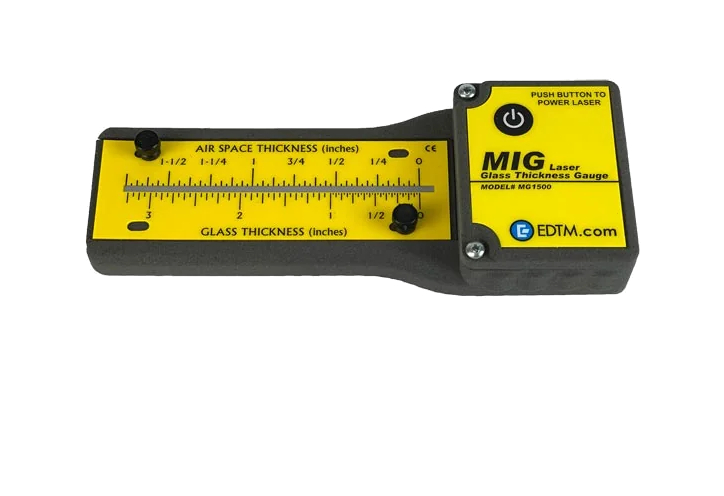
EDTM also offers the MG1500. Check its product page to see how its capabilities line up with the Low-E and laminated glass needs above before you choose.
Practical Tips for Accurate Results
• Measure at the bottom center of the window, the most accurate and repeatable location.
• Confirm the tool’s operating mode matches the job before you start.
• Record Low-E type and surface along with thickness every time.
• If you know the glass manufacturer, you can often narrow down the specific Low-E coating used.
Common Mistakes With Low-E and Laminated Glass
• Ordering by thickness alone and ignoring the coating type
• Assuming every unit in a building uses the same coating
• Treating total laminated thickness as if it described the glass layers
• Skipping the surface location when recording a Low-E result
• Measuring away from the bottom center of the window
Each of these is a recording or technique problem, not a tool problem. A consistent checklist solves most of them.
Frequently Asked Questions
Can a glass thickness measuring tool detect Low-E coatings?
Some can. The Glass-Chek PRO and ELITE detect Low-E coatings, and the PRO reports hard coat or soft coat and single, double, or triple silver.
Which tool identifies laminated glass?
The GC3200 Glass-Chek ELITE identifies laminated glass and measures the laminate inner layer.
Why does Low-E type matter when replacing glass?
Using the wrong coating can negatively affect the energy performance of the window and make it look different from the rest of the building.
Does it work on triple pane windows?
Yes. Both the PRO and the ELITE measure triple pane windows with a single push.
The Bottom Line
For Low-E glass, choose a tool that identifies coating type and surface. For laminated glass, choose one that identifies and measures the laminate layer. Review EDTM’s glass thickness gauge lineup to match the tool to your most demanding windows.