
Knowledge Center
What's the Difference Between a Glass Thickness Gauge and a Glass Thickness Meter?
Short answer: in everyday use, the two terms overlap, and many suppliers use them for the same kind of tool. Some people use "gauge" for simple mechanical tools and "meter" for electronic instruments, but there is no formal split. What matters is what the tool can measure, not which word is on the box.
Key Takeaways
• EDTM’s own product names combine both words, for example "Glass Thickness Gauge Meter."
• Search results for both terms generally describe the same category of tool.
• Compare features instead: what it measures, whether it detects Low-E, whether it handles laminated glass, and its thickness range.
• For sealed insulated glass units, look for a tool that reads glass, air space, and overall thickness in place.
How the Two Terms Are Used
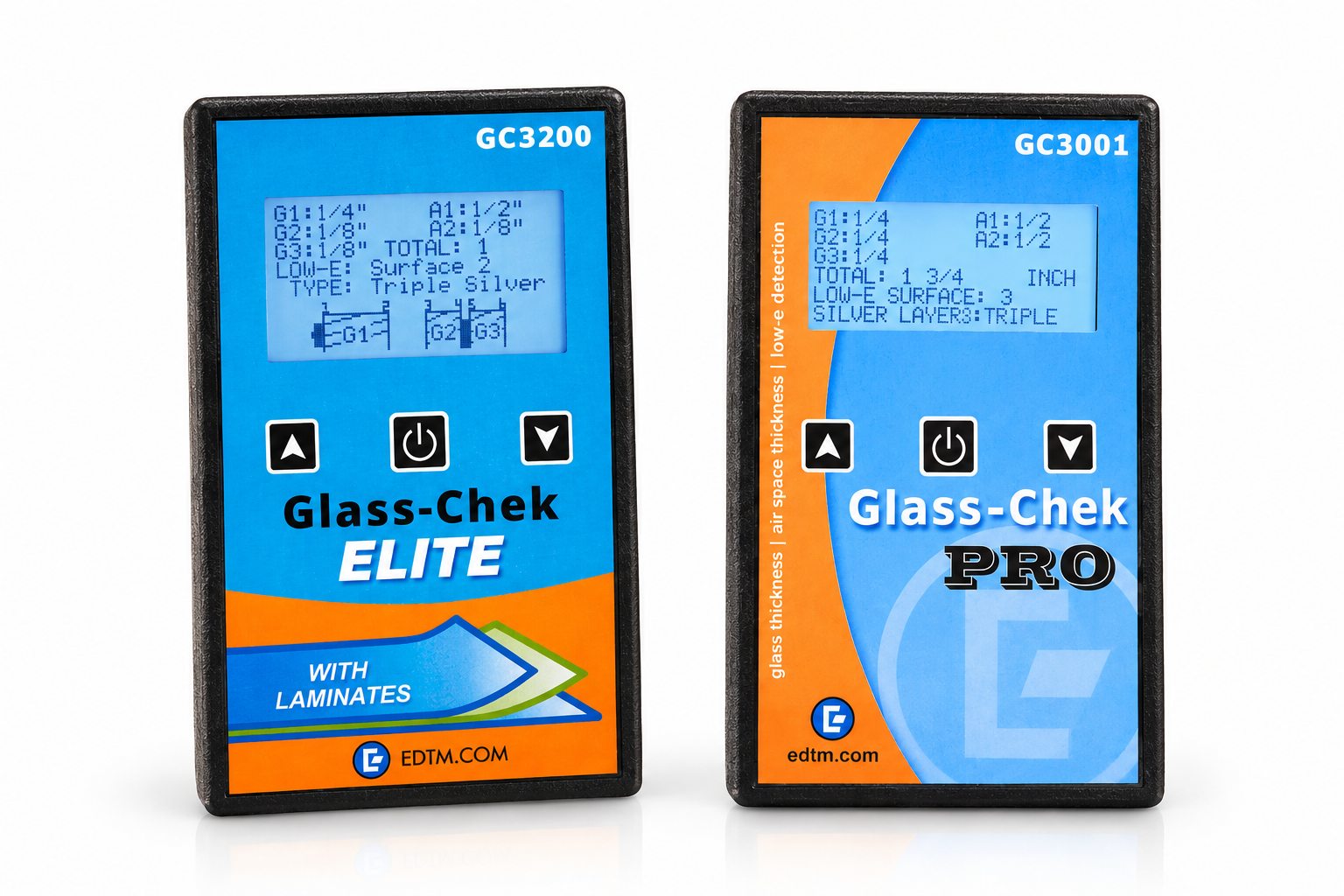
Search for glass thickness gauge vs. glass thickness meter and you will find the words swapped freely. Some buyers say "gauge" when they picture a simple mechanical device that gives one thickness, and "meter" when they picture an electronic instrument with a display. That is common usage, not an official definition. EDTM’s own listings show how blurred the line is: the GC3001 and GC3200 are both titled "Glass Thickness Gauge Meter."
Gauge vs. Meter: A Practical Comparison
|
Question |
Simple tool people often call a gauge |
Electronic tool people often call a meter |
|
What it usually reads |
One overall thickness |
Glass, air space, overall thickness, and sometimes more |
|
Works on sealed units |
Often needs an exposed edge |
Can read through installed glass |
|
Low-E information |
No |
Some models, such as the Glass-Chek PRO and ELITE |
|
Laminated glass |
No |
Some models, such as the Glass-Chek ELITE |
|
Display |
Mechanical readout |
Electronic display |
The table describes common usage. Always check a specific product’s specifications.
What Matters More Than the Name
What it measures
For insulated glass, you want separate readings for each pane of glass, the air space, and the overall unit. The Glass-Chek PRO measures all three on double and triple pane windows.
Low-E detection
A Low-E coating affects performance and appearance, so a tool that identifies it saves guesswork. The Glass-Chek PRO displays whether a coating is hard coat or soft coat and, for soft coat, whether it is single, double, or triple silvered.
Laminated glass
The Glass-Chek ELITE identifies laminated glass and measures the laminate inner layer, while the Glass-Chek PRO displays total laminated thickness.
Range and portability
The Glass Chek Pro has an expanded range of approximately 2 inches, runs on a 9-volt alkaline battery, and includes a carrying case.
How to Choose, Whatever You Call It
1. List the glass you measure most: single, double, triple, Low-E, laminated.
2. Write down what you need the readout to tell you: layers, coating type, laminate.
3. Check each tool’s range, units, and power source.
4. Ask who supports it and where it is made.
5. Compare the total cost of a wrong order against the cost of the tool.
For a detailed buying framework, see our glass thickness gauge buying guide. For a tool that reads a sealed unit in place, review EDTM’s glass thickness meter range.
Other Search Terms You Will See
Buyers also search for a glass thickness measuring tool, a glass thickness detector, and a glass air space thickness detector. EDTM’s own category page for these products is titled "Glass & Air Space Thickness Detector." Different words, same goal: find out what is inside the glass. Treat them all as one family and evaluate the features.
Two Common Jobs and What They Need
|
Job |
What you need from the tool |
|
Order a replacement IG unit |
Each pane, the air space, overall thickness, and Low-E type |
|
Inspect laminated glass |
Laminate identification and inner layer thickness |
|
Spot-check production units |
Quick readings of every layer on sealed units |
|
Check an exposed edge |
A single overall thickness may be enough |
Questions to Ask a Supplier
• Does the tool read sealed units in place?
• What does the display show: glass, air space, laminate, overall, Low-E?
• What is the thickness range?
• Which units can I choose?
• Is a carrying case included, and what battery does it use?
• Who do I call for technical help?
EDTM’s Two Main Models Compared
|
Feature |
Glass-Chek PRO (GC3001) |
Glass-Chek ELITE (GC3200) |
|
Glass, air space, overall thickness |
Yes |
Yes |
|
Triple pane in a single push |
Yes |
Yes |
|
Low-E detection |
Yes, with hard/soft coat and silver layer classification |
Yes, with location and type shown |
|
Laminated glass |
Total thickness displayed |
Identifies laminate and measures inner layer |
|
Display |
Result screens advanced with arrow keys |
Graphical display drawn approximately to scale |
Frequently Asked Questions
Is a glass thickness gauge the same as a glass thickness meter?
In everyday use, usually yes. The terms overlap, so compare features instead of the label.
Which term should I search for?
Use both. Suppliers use them interchangeably, and a search for either will surface the same kinds of tools.
Can either tool measure air space?
A tool that reads sealed units in place, such as the Glass-Chek PRO, reports air space thickness. A simple edge-measuring tool cannot separate air space from glass.
Choose by Capability
The label matters less than the capability. Match the tool to your glass, and confirm it reports every layer you need.