
Knowledge Center
Low-E Glass Detector Buying Guide: Contact Meters, Cards, and Single-Pane Testers Compared
Quick answer: Choose a dual-pane meter such as the ETEKT+ for installed double-pane windows, a single-pane tester for loose or single glass, and a Low-E card when you want a simple visual check. A Low-E glass detector locates the invisible coating and, on EDTM meters, tells you which surface it is on.
What a Low-E detector does
A Low-E coating is a thin, invisible layer on glass that reduces heat transfer. You cannot see it, so detectors confirm whether it is present and which surface it is on. Surfaces are numbered from the outside in, so surface 2 is the inside face of the outer pane.
The main types
Dual-pane contact meters
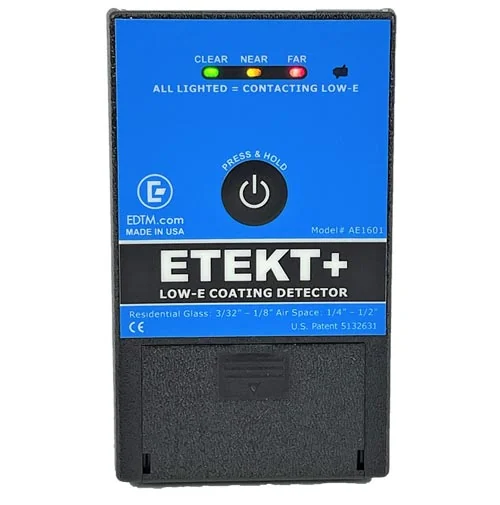
The AE1601 ETEKT+ is a portable meter that detects Low-E and other electrically conductive coatings on or inside a window. A yellow light means the coating is on the near pane (surface 2), red means it is on the far pane (surface 3 or 4), and green means no coating. It detects only the nearest coating it encounters, and the manual notes that metal frames and other conductive materials can affect results.
Single-pane testers
The AE3600 Single Pane Low-E Detector detects coatings on a single piece of glass. It can test monolithic glass or glass assembled into a sealed unit, and it detects through the glass without touching the coating. EDTM's manual states it detects both hard coat (pyrolytic) and soft coat (sputter) Low-E and tests glass up to 1/2 inch (13 mm) thick.
Cards
Low-E cards are a compact option for checking windows. See EDTM's explanation of the difference between the Low-E CARD and Low-E CARD+ for the current feature comparison.
Multi-function meters
The GC3001 Glass-Chek PRO combines glass thickness measurement with Low-E detection, including coating type and surface. The GC3200 Glass-Chek ELITE also measures glass and air space thickness and determines the presence, location, and type of Low-E coating, per its operating manual.
How to choose
|
Your job |
Consider |
|
Installed double-pane windows |
AE1601 ETEKT+ |
|
Single pane or loose glass |
AE3600 |
|
Replacement IGU ordering |
GC3200 or GC3001 (thickness plus Low-E) |
|
Quick sales demonstration |
Low-E card |
Buying checklist
• Which glass will you test: single, double, or triple pane?
• Do you also need thickness readings?
• Will you test in the field or in a shop?
• Do you need coating type, or only presence?
Frequently asked questions
Does a Low-E detector work on any window?
It works on conductive coatings. Results depend on the model and window build, so follow the manual for each meter.
Can one meter find Low-E on a triple-pane unit?
The AE1601 manual says to test both sides of a triple-pane window and notes it only detects the nearest coating. The GC3001 and GC3200 are built for triple-pane testing.
Do these meters need calibration?
One retailer describes the ETEKT+ as never requiring calibration. Check the manual for your model.