
Knowledge Center
How Can You Tell If a Window Has Low-E Glass?
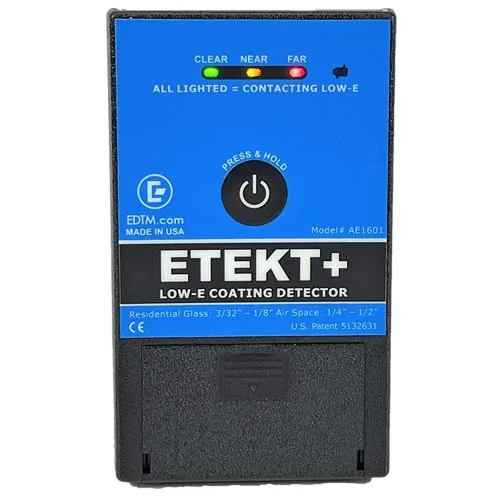
Short answer: You cannot reliably see a Low-E coating by eye, so the dependable way is to test it with a detector. The ETEKT+ Low-E Detector is pressed flat against the glass and its lights show whether a coating is present and where it sits.
Why Low-E is hard to spot
Low-E coatings are thin and transparent. The glass can look clear whether or not a coating is present, which is why Low-E glass detection uses an instrument.
How the ETEKT+ shows the result
The AE1601 manual explains the three lights:
• Yellow (NEAR): the coating is on the near pane, surface 2.
• Red (FAR): the coating is on the far pane, surface 3 or 4.
• Green (CLEAR): no Low-E coating was found.
• If the meter touches the coating directly, all three lights come on, which means the coating is on the surface you are touching.
Steps
1. Make sure the window is reasonably clean.
2. Keep the meter flat against the glass. The manual warns that tilting it or using the small end gives improper results.
3. Test from both sides of the window. If you get no NEAR indication on either side, the window has no Low-E coating.
4. Keep the meter away from the window frame or other metal. Conductive materials can affect results.
The ETEKT+ detects the nearest coating only. For windows with more than one coating, such as a triple-pane unit, test both sides and read the manual's guidance.
Other tools
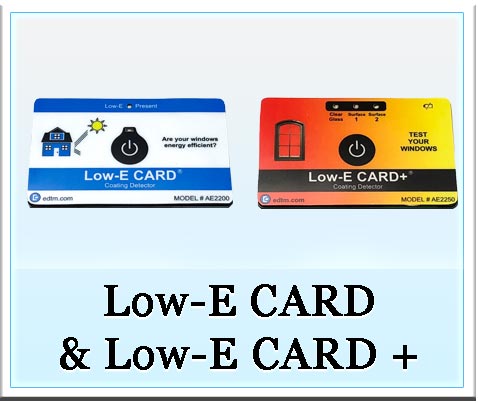
The Low-E CARD+ is another option in EDTM's range. A multi-function meter such as the GC3001 also reports the coating type and surface.
Frequently asked questions
Can I just look at the window?
Not reliably. The coating is invisible.
Does the ETEKT+ only find Low-E?
It detects electrically conductive coatings in general, including Low-E.
Which surface is the Low-E on in most double-pane windows?
It depends on the window. Test it. The meter tells you.