
Knowledge Center
The Complete Guide to Energy Audit Window Testing: Tools, Metrics, and What Auditors Should Measure
Key takeaways: Windows affect comfort, energy use, and fading, but no single tool captures everything. Auditors need to know which metrics a tool measures and which it does not. The WP4501 measures estimated SHGC plus UV, visible, and infrared transmission on installed windows, and Low-E detectors help identify coatings. Other factors, such as air leakage, need other methods.
Windows are one of the most variable parts of a building, and one of the hardest to assess by eye. This guide covers the metrics that matter, the tools that measure them, and the limits auditors should keep in mind.

Key Window Metrics
• SHGC (solar heat gain coefficient): the share of solar heat admitted through the window, from 0 to 1.
• Visible light transmission: the amount of daylight passing through.
• UV and infrared transmission: how much ultraviolet and infrared energy passes through.
• U-factor: a measure of how well the window resists heat flow. It is typically taken from a window's rating label or manufacturer data, not measured by the WP4501.
• Air leakage: how much air passes around and through the window, which requires a different method.
Measuring Installed Windows With the WP4501
The Window Energy Profiler has an opening large enough to fit over the sash of an installed window. It displays four real-time measurements: estimated SHGC, UV, visible light, and infrared transmission. EDTM describes it as a tool for energy auditors in the field to test the performance characteristics of installed windows. The hold button keeps readings on screen, and automatic power-down helps conserve the 9-volt alkaline battery.
Accuracy note: SHGC measurement is not valid on window film or colored glass.
Identifying Low-E Coatings
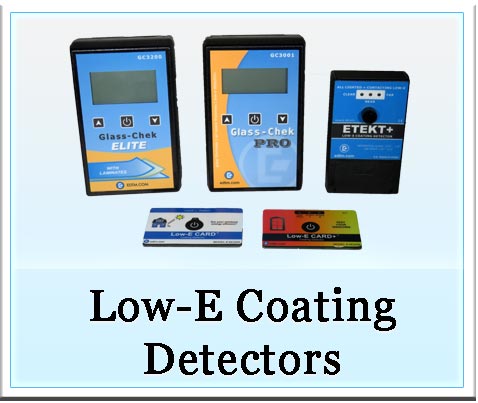
The profiler lets you compare measured numbers with manufacturer data sheets to determine the type of Low-E coating on a window. To confirm whether a coating is present, auditors can also use Low-E coating detectors designed for field use.
What These Tools Do Not Measure
• Air leakage around the frame
• Condition of seals in insulated glass units
• U-factor of the installed window
Combine window measurements with other audit methods for a complete picture of a building.
A Sample Window Audit Workflow
1. List each window by room, orientation, and size.
2. Visually inspect the frame, seals, and glass.
3. Test each window with the profiler and record the four values.
4. Check for a Low-E coating where it matters.
5. Note whether film or tinted glass is present, and flag the SHGC reading as not valid for those windows.
6. Summarize results by window and recommend next steps.
More Tools for the Field
Explore EDTM's field service tools for additional instruments that support field assessments.
Metrics and Tools at a Glance
|
Metric |
How to assess it |
Note |
|
Estimated SHGC |
WP4501 Window Energy Profiler |
Not valid on window film or colored glass |
|
UV, visible, and infrared transmission |
WP4501 Window Energy Profiler |
Displayed in real time |
|
Low-E coating presence |
Low-E detectors |
Choose by glass type |
|
U-factor |
Rating label or manufacturer data |
Not measured by the WP4501 |
|
Air leakage |
Other audit methods |
Outside the scope of these tools |
|
Glass and air space thickness |
Glass thickness meters |
Useful for verifying unit makeup |
Prepare Before the Audit
• Collect any window labels, plans, or documents the owner has.
• Bring a spare 9-volt battery for the profiler.
• Plan the order of rooms so you do not retrace your steps.
• Prepare a form or spreadsheet to log each window's readings.
Report Results Clearly
1. List each window with its location and condition.
2. Show the four profiler readings for each window tested.
3. Flag windows with film, tint, or other factors that limit the SHGC reading.
4. Explain which findings are measured and which come from labels or visual inspection.
5. Close with recommended next steps.
Explaining Results to Owners
Owners care about comfort, fading, and cost. Translate the readings into plain terms and avoid promising exact savings. Show them how windows compare with each other in the same building, since comparisons are easier to understand than raw numbers.
Common Audit Pitfalls
• Presenting an SHGC value for glass with film or color
• Mixing up measured values with label values
• Testing only one window and assuming the rest match
• Skipping documentation of conditions
Frequently Asked Questions
Does the WP4501 measure U-factor?
No. It displays estimated SHGC and UV, visible light, and infrared transmission.
Can auditors use it on windows with film?
SHGC measurement is not valid on window film or colored glass.
What else should an auditor use besides the WP4501?
Use other audit methods for air leakage and building envelope questions, and consult window labels or manufacturer data for U-factor.
Can the WP4501 help identify Low-E types?
EDTM states that comparing measured numbers with data sheets can help determine the type of Low-E coating on a window.