
Knowledge Center
Glass Thickness Tolerance Testing in Manufacturing: How to Verify Specs With a Glass Thickness Meter
Quick answer
Tolerance testing compares what you built to what the spec says you should have built. A glass thickness meter does the measuring half of that job: the EDTM Glass-Chek PRO (GC3001) reads glass thickness, air space, and overall IG unit thickness, and identifies Low-E coating type and location, so a unit can be spot-checked in production in a single push. The tolerance limits themselves come from your own drawings, customer requirements, or standards. The meter gives you the number to compare against them.
Scope note: this article does not state tolerance limits, because they depend on your product and customer specifications. It also does not cite industry standards beyond what EDTM's product information says about display formats.
What does glass thickness tolerance testing verify?
In an insulating glass (IG) unit, several dimensions and features define the spec. A glass thickness tester that reads all of them from the finished unit lets you verify:
• Glass thickness of each pane
• Air space between panes
• Overall IG thickness
• Number of panes, including triple-pane units
• Laminate layers and their thickness (Glass-Chek ELITE)
• Low-E coating type and where it sits in the unit
• Glass deflection in sealed IG window assemblies
EDTM lists production spot-checking as a core application of the Glass-Chek line, alongside ensuring proper Low-E orientation during the production process.
What can a glass thickness meter measure in one push?
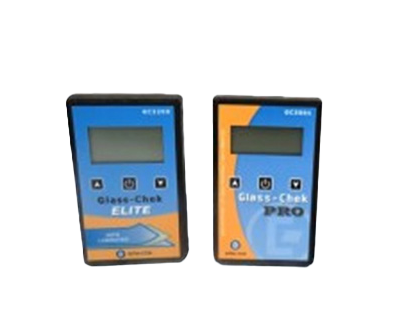
The Glass-Chek PRO measures glass, air space, and overall IG thickness of triple-pane windows at the single push of a button. For all unit types, it covers residential and commercial glass with a thickness range of approximately 2 inches (improved from 1.2 inches). It is compatible with new Low-E coatings, suspended film such as Heat Mirror, and tinted glass, and it displays the total thickness of laminated glass.
The Glass-Chek ELITE (GC3200) adds laminated glass identification. It measures the thickness of the laminate inner layer and shows a graphical display of the window, drawn approximately to scale, with numbers assigned to each piece of glass and glass surface. Its thickness display includes glass, air space, laminate, and overall thickness.
How do you set up a repeatable production spot-check?
A tolerance check is only useful if different operators get the same answer. EDTM's product information points to several features that support that:
1. Take every measurement in the same place. The Glass-Chek PRO Welcome Screen reminds the user to measure in the bottom center of the window, because that location offers the most accurate and repeatable measurement.
2. Confirm the operating mode. The Welcome Screen also shows the current operating mode. Check it matches the application before you measure.
3. Match the display format to your spec. Choose actual values, or values rounded to ASTM Standards in fractions (in inches), thousandths of an inch, decimal millimeters, and other formats. Set the units of measure in the menu so readings line up with the way your spec is written.
4. Step through the results at your own pace. The ARROW keys advance to the next result screen or go back to the previous one.
5. Compare each reading to the spec and record it.
Suggested spot-check log fields
EDTM's product pages do not prescribe a log format. The fields below are a practical suggestion, not a manufacturer requirement.
|
Field |
Why it matters |
|
Product, order, or batch number |
Ties the check to a specific unit |
|
Spec value for each pane, air space, and overall thickness |
The reference the reading is compared to |
|
Measured value for each |
Shows the result |
|
Display format and units used |
Prevents unit mix-ups between operators |
|
Low-E type and location found vs. specified |
Verifies coating and orientation |
|
Pass or fail against your tolerance |
Your own limit, not the meter's |
|
Operator and date |
Traceability |
How do you verify Low-E type and orientation in production?
Getting the coating wrong can have real consequences. EDTM notes that the wrong coating can negatively affect the energy performance of a window, and that the coating significantly affects how a window reflects light, so a mismatch can make a window look significantly different.
When the Glass-Chek PRO detects a Low-E coating, it shows whether it is hard coat or soft coat. For a soft coat, it classifies the coating as single, double, or triple silvered. It can also locate a Low-E coating on a double-pane window from a single side, and the GC3001 confirms the coating on surface 3 where applicable (not applicable for certain window types).
On the ELITE, a special operating mode can also identify which piece of glass has the Low-E coating when the Low-E surface is placed against the laminate inner layer.
Which glass thickness gauge meter fits a production line?
|
|
GC3001 Glass-Chek PRO |
GC3200 Glass-Chek ELITE |
|
Glass, air space, overall IG thickness |
Yes |
Yes |
|
Triple-pane, single push |
Yes |
Yes |
|
Low-E type and location |
Yes |
Yes |
|
Laminate inner layer thickness and identification |
Total laminated thickness displayed |
Yes |
|
Graphical window display with numbered surfaces |
No |
Yes |
|
Carrying case included |
Yes |
Yes |
|
List price |
$1,499.00 |
$1,699.00 |
Accuracy and resolution: [Insert the published accuracy and resolution specifications from the GC3001 and GC3200 manuals. They were not in the source material for this draft.]
Prices are list prices at time of writing. Confirm current pricing before publishing.
What makes the Glass-Chek line a strong choice over Brand X?
• Reads the whole unit, not just thickness. A basic thickness gauge from Brand X gives you the glass dimension. The Glass-Chek PRO and ELITE also report air space, overall thickness, and Low-E coating type.
• Triple-pane in one push. Glass, air space, and overall thickness for each pane, without repeated measurements.
• Display formats that match your spec. Actual values, ASTM-rounded fractions, thousandths of an inch, or decimal millimeters.
• Eight languages. The GC3001 supports English, Dutch, French, German, Italian, Spanish, Swedish, and Danish, useful for multi-site or multi-country plants.
• Built and supported by EDTM. EDTM designed and developed every element of the Glass-Chek PRO and manufactures it in Toledo, Ohio. EDTM says its glass testing equipment has been trusted by over 5,000 companies worldwide over the last 25 years, with expert service a phone call away.
For help choosing a glass thickness gauge meter for your line, visit edtm.com or call (419) 861-1030.
Frequently asked questions
What is a glass thickness meter?
A glass thickness meter, also called a glass thickness tester or glass thickness gauge meter, measures the thickness of glass, air space, and overall insulating glass unit without taking the unit apart. EDTM's Glass-Chek models also identify Low-E coatings.
Can a glass thickness tester check tolerance?
The meter provides the measured values. You compare them to the tolerance in your own spec. The meter does not set the tolerance.
Where should I measure a window for repeatable results?
In the bottom center of the window. EDTM says it offers the most accurate and repeatable measurement location.
Can I choose the units shown on the meter?
Yes. The Glass-Chek PRO can display actual values, ASTM-rounded fractions in inches, thousandths of an inch, decimal millimeters, and more. Change units in the menu.
Can the meter identify laminated glass?
The Glass-Chek ELITE (GC3200) identifies laminated glass and measures the laminate inner layer. The Glass-Chek PRO displays the total thickness of laminated glass.